About Us
| M | T | W | T | F | S | S |
|---|---|---|---|---|---|---|
| « Apr | ||||||
| 1 | 2 | 3 | 4 | 5 | 6 | 7 |
| 8 | 9 | 10 | 11 | 12 | 13 | 14 |
| 15 | 16 | 17 | 18 | 19 | 20 | 21 |
| 22 | 23 | 24 | 25 | 26 | 27 | 28 |

Choosing between being coached and becoming a coach.
I used to believe that in order to get managers, superintendents and supervisors to be ‘better’ at interacting with their teams in-the-field, ‘better’ at safety leadership, ‘better’ at understanding what safety is all about et cetera, you needed to firstly train them and then get someone in to periodically coach them to make sure they were doing what they said they were going to do and to keep them on the straight and narrow. There is no doubt in my mind now that I was WRONG.
To start with, the idea that we need to make people ‘better’ implies that they are not good to begin with. Hardly a way to encourage cooperation and engagement….
Then I learned that coaching is all about the player (I was using the word “coachee” but feel that ‘player’ better represents the fact that the player has a lot more work to do than the coach, as it should be). The agenda of the interaction between the coach and the player is all up to player and so it is only when the player wants to change or improve some aspect of their life that the word ‘better’ ever comes into the equation. You cannot coach someone on what you want them to get better at, only what they want to get better at.
So, coaching is important. It will make a difference, but how best to do make it happen?
If you bring a coach in and have them coach your people, they will make a difference, quite often a lasting one. But if you bring a coach in and have them develop, mentor and coach your leaders as they learn to be great coaches for their teams you have a sustainable and on-tap resource that will make a huge difference over the long term.
It is a bit like the old proverb “Give a man a fish and you feed him for a day; teach a man to fish and you feed him for a lifetime.” I have seen so many people become much more effective in all areas of their work once they understand the impact they can have as a coach in addition to their impact as a leader and manager.
So, for me, the answer to the question is simple; if you want to make a sustainable impact in the effectiveness of yourself and your teams, learn how to be a coach! Learn the skills, the models, the tips and tricks in using a coaching style in your leadership and management activities and start kicking some goals :).

I often get asked in my workshops to suggest some books to read in order to help workshop participants better understand the topics I talk about. This is an attempt to point them in what I consider the right direction.
This mega-blog attempts to give you my views and thoughts on my current top-20 technical safety / coaching / leadership books. They are not in any particular order as I believe that you should read all twenty of them. They will hopefully whet your appetite on the topics that keep me enthralled and also very busy in Raeda.
I am calling it a ‘mega-blog’ as it is way too large to deserve the name ‘blog’ I hope you enjoy it and the books it talks about.
The Field Guide to Understanding ‘Human Error’ (3rdEd.) Sidney Dekker, Ashgate, 2014
Aimed at helping us understand and distinguish between what Dekker calls the “old view” and the “new view” of safety and ‘human error’, theField Guidemoves us from seeing human error as a cause of something to being a consequence. He reminds us to avoid words like “failure” and to embrace words like “experience” and to step into the shoes of those involved in events in order to try to understand their perspective – their story. Although I have not said much about this book here, I believe it is absolute no-brainer – Just Read It…
Comm check… The Final Flight of Shuttle Columbia.Michael Cabbage and William Harwood, Free Press. 2004.
“It is all about the story” is the title of one of my recent blogs. This book is a fantastic view of the Columbia Shuttle re-entry breakup. It tells the stories from various perspectives. It tells the stories that led to the event. It tells the stories of the participants, and it tells the stories of the management and decision-making teams and processes.
It does not tell us how to do an investigation but I believe it is an important book for those whose job it is to pull together investigation reports. It reminds us to talk to the various perspectives and narratives that need to be told. Of course most of us do not have the time, resources and commitment to write a book about each of the safety investigations we do. We can learn a lot from Cabbage and Harwood about incident story-telling.
Risk Intelligence – How to Live with Uncertainty.Dylan Evans, Atlantic Books. 2012
This interesting (in a good way) book is all about having the right degree of certainty to make sound decisions. It prompted me to think about and to ask others how good we are at knowing what we know and knowing what we don’t know. How risk intelligent are we? This book and it’s concepts is a great thought provoker when doing safety investigations and when thinking about safety and risk management more generally.
Safety Differently – Human Factors for a New Era.Sidney Dekker, CRC Press. 2015
In Dekker’s words, “This book attempts to show where our current thinking is limited; where our vocabulary, our models, and our ideas are constraining progress.” This book brilliantly puts our current approach to safety in perspective of the past, how we got to where we are and then how and why we need to think differently, to “do” safety differently. As Dekker can do so well, he pulls no punches in his messaging and his approach. He is compelling and Safety Differentlyis an essential read for all leaders and ‘safety’ people, whatever that may mean.
Disastrous Decisions – The Human and Organizational Causes of the Gulf of Mexico Blowout. Andrew Hopkins, CCH press. 2012
I have included this book in my top 20 so as to introduce you to Andrew Hopkins if you do not already know his work. Hopkins dedicates a complete book to each catastrophic incident. All Hopkins’ books are excellent, providing a nice balance between the technical discussion on the mechanics of the event in question and a sound analysis of their contributory elements from the many angles and view points that exist.
Pre-accident Investigations – Better Questions.Todd Conklin, CRC Press. 2016
A mixture of quoting and paraphrasing the preface: A basic premise of this book is that we should not care if a worker made a mistake or violated a process – both errors and mistakes are so normal and predictable that they are not even interesting… and never causal.
Todd’s book is all about, as the title unsubtly suggests, asking better questions. Questions that will help us understand how our organization’s processes have let failure manifest into an incident. He very much focuses on learning first, not doing first. And that the only purpose of investigations is to learn and improve.
One quote that I really like: “The prize is not in writing the perfect corrective action; the prize is in asking the perfect question.”
The nuts and bolts of the book are about how to make learning teams work. This is done in seven steps or phases:
“Phase 1: Determine need for Learning Team
Phase 2: First session: Learning mode only
Phase 3: Provide “Soak Time”
Phase 4: Second Session: Start in learning mode
Phase 5: Define current defenses / build new ones
Phase 6: Tracking actions and criteria for closure
Phase 7: Communicate to other applicable areas”
To me, the power of this approach lies in the involvement of those who actually know what their day-to-day work looks like in the (investigation) team, talking through and explaining what I would call Work-As-Normal.
Organizational Accidents Revisited. James Reason, CRC Press. 2016
Reason does a brilliant job of re-capping his earlier – somewhat similarly looking – book of 1997 and then goes on to share some ideas about how to help our people get better at being ERROR – AWARE through foresight training. Chapter eight is an excellent overview of those thinkers who have a slightly, or significantly, different view than Reason. He touches on Turner, Leveson and of course Charles Perrow and Jens Rasmussen – all of which should also be read. But I cannot include every book in my top 20…
James Reason touches on FRAM (Functional Resonance Analysis Method) – the baby of Erik Hollnagel. FRAM is a tool that after many re-reads of the book I do not quite get, but do acknowledge there is something significant in there.
Organizational Accidents Revisitedis a very easy and worthwhile read, especially for those of you using ICAM (Incident Cause Analysis Method).
Start with Why – How Great Leaders Inspire Everyone to Take Action. Simon Sinek, Penguin. 2011
From an on-line review: “According to Sinek, most leaders talk about WHAT they do – the products or services that make them money. Some leaders talk about HOW – the process they use that sets them apart. Very few leaders talk about (or even know) their WHY – the reason the business exists in the first place.”
This is an awesome book and I mean that in the traditional sense. I was struck by the realization of why starting with why is such an imperative in all we do. It is, with the wonderful power of hindsight, so obvious. If somebody knows WHY doing something is going to help them be better, their life be simpler, healthier or their business be more impactful and they know their why to the depth of their bones – really get it – they will be unstoppable.
I use this concept in all my coaching workshops and in many coaching activities and very much use it when helping leaders at all levels get better at workplace incident investigations by helping them think differently.
In summary, read this book! It is not only about leadership but is also about how we need to think about all we do.
The Challenger Launch Decision: Risky Technology, Culture and Deviance at NASA. Diane Vaughan, University of Chicago Press. 1996
The best overview I can give you in order to encourage you to read this prodigious book is from the preface to the book itself:
“The cause of the disaster was a mistake embedded in the banality of organizational life and facilitated by an environment of scarcity and competition, elite bargaining, uncertain technology, incrementalism, patterns of information, routinization, organizational and interorganizational structures, and a complex culture.”
This book covers issues such as ‘learning culture’, the normalization of deviance, the culture of production and structural secrecy. Topics that are well worth understanding and absolutely do not only apply to space shuttle accident investigations.
Drift Into Failure: From Hunting Broken Parts to Understanding Complex Systems. Sidney Dekker, Ashgate. 2011
As usual, Dekker writes to an educated audience and that makes most of his books a tad tough to read for some. Having said that, I thoroughly recommend that you read them all – twice.
What I love about this book is that it offers examples (stories) that help paint the picture Dekker is trying to paint. He gets us to think beyond Newtonian cause and effect thinking to that of complexity and relationship. He also gets us beyond the black and white of Descartes to the many shades of grey.
In many ways, this book is about complexity of systems and finishes up talking about the complexity of drift – the final sentence sums it up: “Complexity allows us to invite more voices into the conversation, and to celebrate the diversity of their contributions. Truth, if there is such a concept, lies in diversity, not Singularity.
A great companion to Drift Into Failureis Scott Snook’s Friendly Fire: The Accidental Shootdown of U.S. Black Hawks over Northern Iraq. Princeton University Press. 2000
Friendly Fire: The Accidental Shootdown of U.S. Black Hawks over Northern Iraq. Scott Snook, Princeton University Press. 2000
This book is the ultimate example of why the concept of ‘root cause’ in sometime complex socio-technical workplace safety incident investigations is a pretty meaningless concept.
It also explores both as a concept and through an excellent narrative, the idea of practical drift. Snook gives us the narrative from the various perspectives of those intimately involved: the individual-level account; the group-level account; the organizational level account and what Snook calls a cross-level account – how the various stories and perspectives all fit together. This is a good book to read alongside Dekker’s Drift Into Failure.
Verbalisation: The Power of Words to Drive Change. Sven Hughes, Verbalisation Limited. 2017
Verbalisation, at least in the context of safety and safety-related incidents, teaches us all about learning (as compared with sharing, which we tend to to ad nauseumafter an incident). To me and to many others, including Karl Weick and Kathleen Sutcliffe in Managing the Unexpected, learning is all about cognitive changes that manifest in changes in behaviour. This is what Verbalisationis all about, To me it appears that this book is also about an advertising exercise for the company (Verbalisation Limited) but I hope you too can see past that and get the huge amount of help I got in relation to tailoring messaging to specific audiences in order to maximize learning. And that is something we all need to get better at.
Turn the Ship Around: A True Story of Turning Followers into Leaders. L. David Marquet, Portfolio Penguin. 2013
This book should be essential reading for anyone who purports to lead others. The simplest way to get your head around Marquet’s ideas is to watch the You Tube clip called “Intro-versity presents “Greatness” by David Marquet”.
I am confident it will pique your interest enough for you to rush out and by the book. Turn the Ship Aroundis a story that develops the ideas that shaped Marquet’s views on, and practices of, leadership. It’s ideas remind me somewhat of coaching, wherein the answers to a problem lie, not with the coach, but with the player – the person being coached.
Marquet eloquently describes how he moved from directive to intent-based leadership and the massive impact it had on his life as a submarine commander in the US Navy. One aspect that I love (and used in my book) is at the end of each chapter he adds a handful of “Questions to consider” which attempts to make the topic discussed in the chapter relevant and real for the reader, their leadership and their organization. To sum up, I will upgrade my opening sentence: This book mustbe essential reading for anyone who purports to lead others.
Investigative Interviewing Psychology and Practice. Rebecca Milne and Ray Bull, John Wiley and Sons. 1999
A brilliant and insightful blend of the theory (why) and the practice (how) of interviewing. Aimed at lawyers, social workers, judges and pshychologists, I believe it is just as powerful for safety professionals and coal-front leaders who want to understand what people did or saw during a workplace safety incident. Milne and Bull talk about memory creation, memory duration, question types and styles during interviews, and most importantly, and I feel most interestingly, details about how to undertake an enhanced cognitive interview.
This book is well worth at least two reads if a part or your world includes interviewing after incident or helping others improve their interviewing skills.
Safety I and Safety II: The Past and Future of Safety Management. Erik Hollnagel, Ashgate. 2014
Hollnagel starts this insightful book with an exploration of the etymology of the world ‘safety’. It is a very old word…
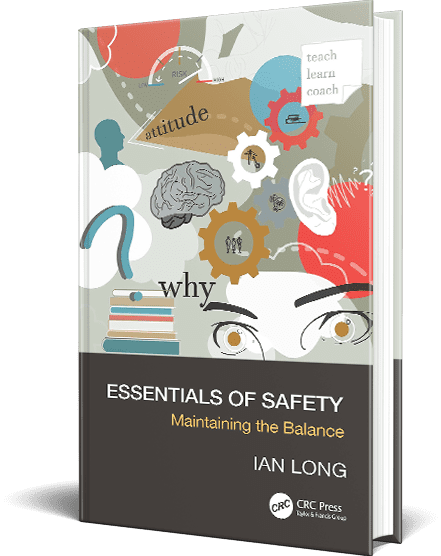
The main idea of Safety I and Safety IIis that Safety I is defined as a condition where as little as possible went wrong and that Safety II is defined as a condition where as much as possible goes right. It is mainly from this great book that I built (the search for gaps between) Work-as-Done, Work-as-Normal and Work-as-Intended as the basis for constructing ‘timelines’ and focusing safety investigations discussed in my book Simplicity in Safety Investigations.
Safety II in Practice: Developing Resilience Potentials. Erik Hollnagel, Routledge. 2018
I must confess that The FRAM instance on the cover initially scared me off a bit. I persevered however and am very glad that I did. Providing an overview and some new perspectives on Safety II beyond his previous work, Hollnagel moves into an explanation of Resilience and Resilience Potentials. This is such an important concept. I feel that if you are in any way connected to the creation of ‘safe work’ as a doer, a leader or a functional safety expert, you needto know this stuff.
I must also confess that I got a bit lost when Hollnagel starts explaining how to measure and plot the Resilience Potentials and how to describe their relationships using a FRAM. But that is my failing and you may really get that bit. This book is well worth a couple of reads.
Human Factors & Ergonomics in Practice: Improving System Performance and Well-Being in the Real World.Edited by Steven Shorrock and Clare Williams, CRC Press. 2017.
By review on Amazon: “Every now and again, I read a book that makes a difference in my life. This is one of those books. Before reading Human Factors & Ergonomics in Practice, I had a bit of a sense about what Human Factors (HF/E) was. I have read all of Dekker, Hollnagel, Reason and many others who all talk about HF/E and I have been exposed to investigation methods that ascribe to the ideas of HF/E. I even talk about it a little in my book, but I never really got it. Steven Shorrock and Clare Williams, along with a band of merry practitioners clearly describe what HF/E is, what HF/E is not, and provide a plethora of domain-specific examples and practitioner-centric thought that all comes together to help set the ideas of HF/E in the mind of the reader. In creating Human Factors & Ergonomics in Practice, Shorrock and Williams have given us an accessible balance between text and narrative that will be a benchmark for a long time to come.
Some of the chapter contributors that I instantly recognized are: Erik Hollnagel, Sidney Dekker, Ron Gantt, Paul Salmon, Daniel Hummerdal, Martin Bromiley and Don Harris. Divided into four parts, Claire and Steven have masterfully brought together expert theorists and expert practitioners in the field of HF/E to tell their stories that explain so much, especially to a layman like me.
Coaching for Performance: Growing Human Potential and Purpose(4thed). John Whitmore, Nicholas Brearley Publishing. 2009
The first edition was published in 1992 and I wish I had read it back then. This essential book covers all the basics such as what coaching and what coaching is not, the GROW model – that stalwart of the art of coaching, along with some great questions that you can use with it. All this is done in excellent detail along with some great practical advice and expert insight into details such as barriers to coaching, coaching teams, leadership coaching and transpersonal coaching.
Although not specifically focused on, I found Whitmore’s book invaluable as I tried to become more effective in investigating workplace safety incidents and attempting to help other people learn how to do their investigations.
Controlling Risk in a Dangerous World: 30 Techniques for Operating Excellence. Cpt. Jim Wetherbee, Morgan James Publishing. 2016
This is a brilliant book – “Operators don’t managerisk; they controlrisk.”
Wetherbee uses personal stories (and those of others he knows and has worked with over many years) very effectively. We learn through stories and he is a master story-teller.
Rather than a more high-level review, I am going to hone in on each of his “30 Techniques for Operating Excellence”, quoting them and then adding my thoughts and explorations as to questions and topics of interest related to the technique that may be useful in our day-to-day work as a leader or as an investigator after something has gone wrong. I know this review will end up being way too long, but I really want you to get enough of a sense of where Wetherbee is going that you will simply go out and buy the book.
Operators cannot identify hazards reliably or control risk effectively without mastering ‘Develop and Maintain Risk Awareness’
To start with, purposefully developing an awareness of risk. Look for it. Think about it. Chronic unease plays a part here. The more this is done, the more the awareness moves away from directed attention and conscious effort to becoming automatic over time. Ability becomes skill when we no longer have to think consciously about performance.
Leadership / Investigation Thoughts:
o If so, how was the change identified and managed?
i. Will I, or anyone on my team be injured? If so, how badly? How can I prevent an incident?
i. Apply the hierarchy of controls – top to bottom
Leadership / Investigation Thoughts:
o What about lines of fire, anomalies, changes, subtle energies and subtle changes?
o Better risk attitude people have a higher perception of risk and a lower propensity to accept risk. The opposite tend to be over-confient.
o Risk intelligence is more about whether they know the limits of their understanding.
o Do practitioners / operators / maintainers try to improve their risk attitude by enhancing their perception of risk and reducing their personal propensity to accept risk, commensurate with the importance of the mission and their ability to control the hazards.
There are only two ways to get into trouble with procedures: not following them, and following them blindly.
Managers should ask each front-line leader in the organization these questions:
i. If the answer is ‘NO’ to question one, then fix the procedures and do not expect or demand compliance. Same for question two.
One of the best ways to reduce errors is to use procedures when conducting complicated operations. It is important to remember, however, that violating a rule does not always result in an accident or injury. Rare events happen rarely.
This is howoperators should be thoughtful when using a procedure thoughtfully.
Leadership / Investigation Thoughts:
o The worst consequenceif they do not control the hazards,
o The criticalityor importance, of the mission they are involved in,
o Their ability to controlthe hazards?
Leadership / Investigation Thoughts:
o I intend to…
o Hold hand over controls briefly before activating (telegraphing the action)
o Verbalise intended action, to self and/or others around: “I am going to open valve B21”
Leadership / Investigation Thoughts:
i. Just check it. Review the procedure after the action and check that all steps were carried out as per the procedure.
i. Two different types of gauges that monitor the same variables. Or two different people cross-checking that a task has been completed. For example, “Cabin crew, set doors to automatic and cross-check”
i. Is there an independent system we can check? Or cross-check? Can we look at the system from a different perspective? For example, after setting four switches two down and two up, look at the pattern of switches and check it is as planned.
Leadership / Investigation Thoughts:
Taking care of your gear will prevent failures and extend the life of the equipment, also minimising the likelihood of failures.
Leadership / Investigation Thoughts:
Expect failure in yourself, what you are using and everyone else. (I assume everyone else on the road is trying to kill me). Chronic unease fits in here. Always have a back-up plan. Anticipate a failure and already know what you are going to do. Always be ready for failure.
Leadership / Investigation Thoughts:
In order to understand how errors are made and to learn how to develop and use techniques to avoid adverse consequences from errors made so easily.
Leadership / Investigation Thoughts:
You must have an overall understanding of the mission, capabilities, purpose of the activity, equipment and systems to be used beforeyou can explore the critical phases and build a plan.
Leadership / Investigation Thoughts:
o Build an outward focus and sense emergent hazards immediately
o Predict trigger steps, consequences and ‘What if?” scenarios (chronic unease)
o Expect failure
o Conduct task post-mortems
o Be ready to change the plans if needed.
o Maintain a suitable level of situational awareness
o Anticipate increasing risk and always be ready to invoke a contingency plan (See technique 12)?
As you prepare for the task, and after you have identified your trigger steps and critical phases, develop in your mind what you will do if any of these steps do not go as planned. How will you recover from the situation beforeit develops into a catastrophe or injury?
Leadership / Investigation Thoughts:
This is the most powerful technique. The further you operate from danger, the more likely will be your chances to complete the mission.
Leadership / Investigation Thoughts:
i. Maintain accurate knowledge of local environment
ii. Anticipate potential conflicts or collisions
iii. Assume the worst
Leadership / Investigation Thoughts:
Supreme confidence must be tempered with healthy self-doubt. Without confidence, operators will make mistakes. Without humility, operators will not realize they are making mistakes. Always ask yourself “What have we missed?” “What mistakes have we made which can be corrected before it is too late?”
Leadership / Investigation Thoughts:
This is all about maintaining the right attitude before and during an operation. This can be different for different people in different situations. It is all about the attitude that works best for a person to resist the psychological pressure and avoid cognitive incapacitation. A simple example is stage fright. A simple mindset in this case is to remember that the only important people in the room are the audience, not you. You are irrelevant. The audience receiving a good experience is all that matters.
Leadership / Investigation Thoughts:
o The technical knowledge of the practitioner / operator / maintainer and the team,
o The team members (and the individual practitioner / operator / maintainer’s own) strengths and weaknesses related to the task,
o Their level of T-zero vigilance,
o The balance between controlling and automatic cognition,
o The ranging and variation in their focus (narrow – world view) during the task
The best operators must think fast. Yet not act too fast. They must assess the situation and process information quickly but must not rush and make mistakes. Operating excellence comes from being deliberate, not being fast.
Leadership / Investigation Thoughts:
The best operators are highly skilled in identifying the early signals of an impending accident and taking corrective action to prevent the accident and improve operating performance. They identify “weak signals”.
Leadership / Investigation Thoughts:
o Change in scope of work
o Unexpected event or situation
o Abnormal event or situation
o Minor failure
o Hurrying
o Distraction
o Fatigue
o Psychological of physical stress
o Interruptions and distractions
o Tasks that cannot be executed in their normal practiced sequence
o Unanticipated new task demands arise
o Multiple tasks that must be performed concurrently.
Collectively, through sharing and conversations and challenging, teams, build a common mental model of the work and each person’s role within it. The same is true for each member; sharing their mental models helps them have clarity. This reminds me of the intent model of David Marquet.
Leadership / Investigation Thoughts:
The idea here is not only challenge the ‘no-go’ decisions, but also the ‘go’ decisions. Spend sufficient time to think about whether it is actually right to proceed, rather than just doing it.
Leadership / Investigation Thoughts:
Speak up. You are the one at risk, not the manager. If you are the manager, encourage and reward speaking up.
Leadership / Investigation Thoughts:
You need to be very aware of your own limitations, the limitations of the other team members, the limitations of the tools, equipment, software and the limitations of the procedures you are using. Make your decisions and actions based on these limitations.
Leadership / Investigation Thoughts:
Do not just rely on the fact that people have been trained.
Leadership / Investigation Thoughts:
Groups perform better than individuals because the group can overcome the weaknesses of some members with the strengths of other members. The group greatly benefits when team members share their weaknesses. Look for, and value people who understand and acknowledge their weaknesses, know the limits of their capability, and are eager to learn and develop ways of mitigate their weaknesses.
Leadership / Investigation Thoughts:
When an error is admitted quickly and candidly to teammates as soon as the error is recognized, corrective actions can be taken to mitigate the consequences more effectively and completely.
Leadership / Investigation Thoughts:
Humans are poor at remembering to do things into the future. Put your house keys next to your car keys so you don’t forget them. Set alarms so you don’t forget things at certain times.
Leadership / Investigation Thoughts:
Do as I do, as well as what I say. You cannot demand operating excellence from others if you don’t believe in it and do it yourself.
Leadership / Investigation Thoughts:
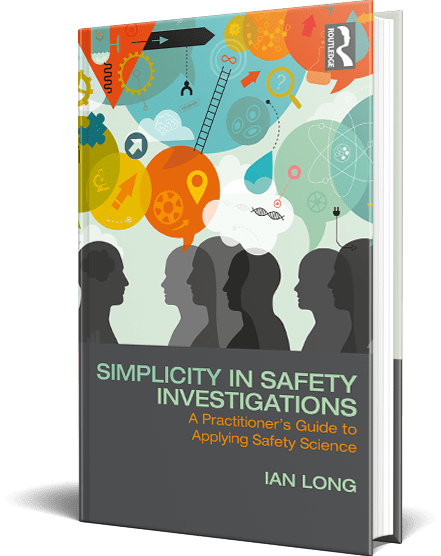
Simplicity in Safety Investigations: A Practitioner’s Guide to Applying Safety Science. Ian Long, Routledge. 2018
Hey, of course I am going to put this one in J
I must confess that it is not easy, or even maybe possible to critically review your own book, so I will, instead try to portray what I was trying to achieve in its’ writing.
The aim of Simplicity in Safety Investigationsis to give practical guidance for an innovative approach to both simple and complex incident investigations, by bringing together the works of great safety science thinkers such as Sidney Dekker, Todd Conklin, Erik Hollnagel, Daniel Kahnemann, James Reason and Dylan Evans, alongside my own industry experience. The book is intended to be an easy-to-follow reference for supervisors, managers, and safety practitioners across many industries. It is innovative in the sense of Erik Brynjolfsson and Andrew McAfee’s ‘Recombinant Innovation’ from their book The second Machine Age. This is the idea of recombining things that already exist.
There are four main chapters. The first two focus on our mindset as we approach and undertake investigations and the simple things we all must do before an investigation starts. The third chapter is a step-by-step guide on how to undertake both simple and more detailed workplace incident investigations. Chapter four is reserved for a more detailed review and set of explanations around the science and thinking behind the method and approach.
Summary of mega-blog
Although I have only covered 20 books here I hope that in the reading of the books themselves, you become interested in the topics covered and think and talk about them with others. I also hope you read more of the books on the topics of interest to you and continue to help make your workplace and the world a safer place.
Ian

Here are a few things we can have some great conversations about that have the potential to make a real difference out there: Defining safety, Resilience, Reducing procedural complexity, WAD vs WAI, Decision making, Ask how things can go wrong, Flexible incident reporting, Core competency training. .
How we should talk about and promote Safety Differently
All of the concepts below are from the great works of Sidney Dekker, Eric Hollnagel, Todd Conklin and Daniel Kahneman.
Defining safety as the presence of positive capabilities, capacities and competencies that make things go right and not as the absence of things that go wrong.
Resilience. Resilience is often described as the ability to bounce back, to accommodate “unexpected” change and to absorb uncertainties without falling apart. In the face of potential disturbances, changes and surprises: For either the safety system or an individual/team:
o The ability to anticipate (knowing what to expect)
o The ability to notice (knowing when and what the disruptions are and look like)
o The ability to respond (knowing what to do, or at least to plan to respond)
o The ability to learn (knowing how to adapt the work to prevent the disruption now and next time)
Reduce procedural complexity
o Understand ‘Complex’ versus ‘Complicated’
o Simplify complexity slowly, carefully and mindfully
Work-As-Done versus Work-As-Intended (WAD vs WAI) and the fact that there is virtually always a mismatch between actual work and written guidance.
o We need to understand how we do work normally.
o Get into the habit of seeking out and explaining drift during normal work.
o Drift usually results in safe work – A TRIF of 10 equals 99.999% safe work.
How people make decisions in the work place:
o Answering a different question
o Intense task focus – Cognitive fixation
o What you see is all there is (WYSIATI)
o Good gets worse. Bad gets better – Regression to the mean
o Using the right expertise?
Continually asking how things can go wrong.
o Past successes in safety is NOT a guarantee of future safety
o A Preoccupation with failure
In relation to incidents and investigations:
o Recognise that “Loss of situation awareness” or “failure to recognise the hazard” are just fancy words for “human error” that do not help during investigations.
o It is very difficult, if not impossible to recreate events. The outcomes are simply stories that fit our hindsight views.
o Allow flexibility in event reporting, with a narrative of explanations. Even multiple narratives that result from multiple perspectives.
o We need to stop;
In relation to core competency training:
o When and how (and when not) to adapt procedures to local circumstances
o Communication
o Coordination, including task assignment
o Problem solving
o Risk conversations (including when it all seems well)
o Generating and allowing different perspectives including WYSIATI
o It all looks obvious when you know the outcome (Hindsight bias)
o Note:
“I think people get uncomfortable when I say that if we want to change safety, we have to look into ourselves. We should not look at all those other people (who, we might believe, need to ‘pay more attention and be more careful’). I believe that if we in safety don’t change, nothing is going to change in safety.” – Sidney Dekker “The ‘failed state’ of safety” www.safetydifferently.com. 7 Oct. 2014

5-Whys - Sometimes thinking a bit differently and using a tool to help you get where you want to go can make all the difference. :)
As it has been said: “Like every method, every model and every process, if you approach it with a healthy level of skepticism, pragmatism and a few other “isms” that help you see it as a means to an end rather than a be-all and end-all approach, you will be fine.”
We can, and perhaps should, apply the same philosophy to 5-whys. If we set up a little spreadsheet with cells each with the labels Why? Why? Why? Why? and Why?, we are probably doomed to a very Newtonian (Cause and effect) set of “causes”. However, if we have created our time line in a way that enables us to explore the differences between the way the work was done on the day (Work-As-Done) and the way we might think the way should be done according to the procedures (Work-As-Intended) and used those gaps (or differences) as fodder for the 5-Whys and then had the right conversations to think about the explanations for those gaps, we could be onto something useful.
So we come to thinking about what are the “useful” conversations to have instead of asking “Why?” five times? This is, once again, time when we need to lean on some of the great safety thinkers and scientists of our time. Names like Sidney Dekker, Eric Hollnagel and Daniel Kahneman come to mind. Instead of asking “Why?” we could be talking about the level of resilience the safety system has, or the level of resilience the individuals involved have. We could be asking about the level of complexity in the procedures and the complexity of the task that may have made their lives difficult. We could talk about the way those involved viewed their world at the time and how they made their assessments of the situation and what drove the actions we later decided were not good ones. How about a conversation about the competencies, capacities and skills of those involved? Or checking out whether drift played a part is setting us up for failure?
These are the sorts of conversations that will make a difference in our understanding of the “incident” and steer us toward explanations of observed actions and assessments, rather than to “causes” of incidents.

In simple language, resilience is often described as the ability to bounce back, to accommodate ‘unexpected’ change and to absorb uncertainties without falling apart. In the face of potential disturbances, changes and surprises. It represents, or explains, the safety system's ability to anticipate (knowing what to expect), its ability to notice (knowing when and what the disruptions are and look like), ability to respond (knowing what to do, or at least to plan to respond), and ability to learn (knowing how to adapt the work to prevent the disruption now and next time).
So where is a good place to start when talking about Resilience? There are a couple of authors who will be far more eloquent in their descriptions of Resilience than I ever will be. Eric Hollnagel and Sidney Dekker both talk a lot about Resilience and I recommend them to you if you have an interest in the subject.
I think Resilience goes beyond just the safety system and how we ‘do’ safety in the real world. I feel that an individual can show resilience as defined above, as can a business. ‘Resilience’ is one of those wonderful things that you can think about not only after an unwanted outcome of an event, but before hand as well. The language of resilience is great fodder for conversations when you are out and about as a leader. You can explore with the guys and girls pout in the plant or mine about how they prepare for the unexpected, which bits of their tasks they have to watch out for, and what they pan to do when it all goes wrong. These can be great conversations starters.
So, what does this look and feel like in practice? Ask what could go wrong. Not only the low-level hazard stuff, but the high level catastrophic failures – the fatal risk questions. Be in a state of chronic unease. Do not be lulled by a good run of safety. Do not be surprised when things do go wrong. Be in a position to say; “Yep, we knew that might happen. This is what we had planned to do about it and we have done exactly that”. Below are some questions that may prompt some great conversations about resilience either in the normal course of a leader spending time in the field with his/her people, or when interviewing or investigating after an incident:
Inspirations for interview questions for Resilience – What is the level?
• In the preparation of a take five or a JSA/THA, what level of thought do you put into what could go wrong?
• Which specific parts of a task do you need to vigilant around?
• How best do you prepare to respond to any expected disruptions?
• What do you do if something unexpected happens? For example, an interruption, a new urgent task, an unexpected change of conditions, a resource that is missing, something that goes wrong, et cetera?
• Before you start a task, or at a point during a task, what process do you follow that would, or could, look for, or think about any potential disturbances, surprises and changes that could happen?
• How do you monitor what is going on within your task, or around you, to check that there are no disturbances arising that might interact with you in the completion of your task?
• How do you keep an eye on things that may become a threat in the near future?
• Did you observe anything in particular to make you think something might not go as planned?
• What level of your thought goes into the long-term drift and trends about the way you are doing the task? Have you always done it this way?
• What has changed over the last few months about the way we do the task?
• What do you need to keep an eye on in terms of keeping any long-used shortcuts you have developed in focus?
• What have you learned from the last time you did the task? The way you did it?
• What could happen that is not expected?
• Do you know of any previous incidents or near misses involving this task or similar tasks?